


If you’re not sure whether a massive AI data center is proposed in your region, there are pretty good odds the answer is yes.
Here in New Mexico, most people have heard about Oracle’s massive Project Jupiter in Doña Ana County. Fewer people know about close to a dozen projects being proposed, constructed, or discussed in places like Raton, Gallup, Farmington, and Roswell.
But it’s safe to say overall concerns about air pollution, water, and trading tax breaks for promises of jobs and economic growth are rising. It’s a conversation raising questions about both the tradeoffs involved and a lack of transparency.
Several lawmakers have proposed a temporary ban until real guardrails are in place, and Food & Water Watch recently published a fact sheet on that option, citing threats to air quality and water resources.
The issue isn’t data centers per se. Small to medium sized buildings with rows of servers aren’t exactly a new concept. Those have existed in our state since the 1980s and 90s.
Learn More: The Hidden Cost of AI: What Data Centers Mean for New Mexico
It’s the size and scale of AI data centers that makes them different – they bring with them promises of jobs and economic growth, but also significant impacts to our land, air, and water.
So far, these massive projects have arrived in NM with hidden negotiations, promises made and broken, and a fair amount of misdirection. No project better illustrates that drama than Project Jupiter’s secret roll out.
Sign up for our email newsletter to get the latest blogs, news, and policy updates from ProgressNow NM
New Mexico Brings Out The Red Carpet For Project Jupiter
In January 2025, Gov. Michelle Lujan Grisham announced a memorandum of understanding with Borderplex Digital Assets, LLC (the originator/shell company for Project Jupiter). While the announcement received minimal attention at the time, it paved the way for Oracle’s $165B project to skirt state air pollution rules using what’s become known as the microgrid loophole.
Elected officials in Southern NM appear to have been looped into the project later on in 2025, and required to sign non-disclosure agreements (NDAs) shortly before a yes/no vote on the project by the Doña Ana County Commission.
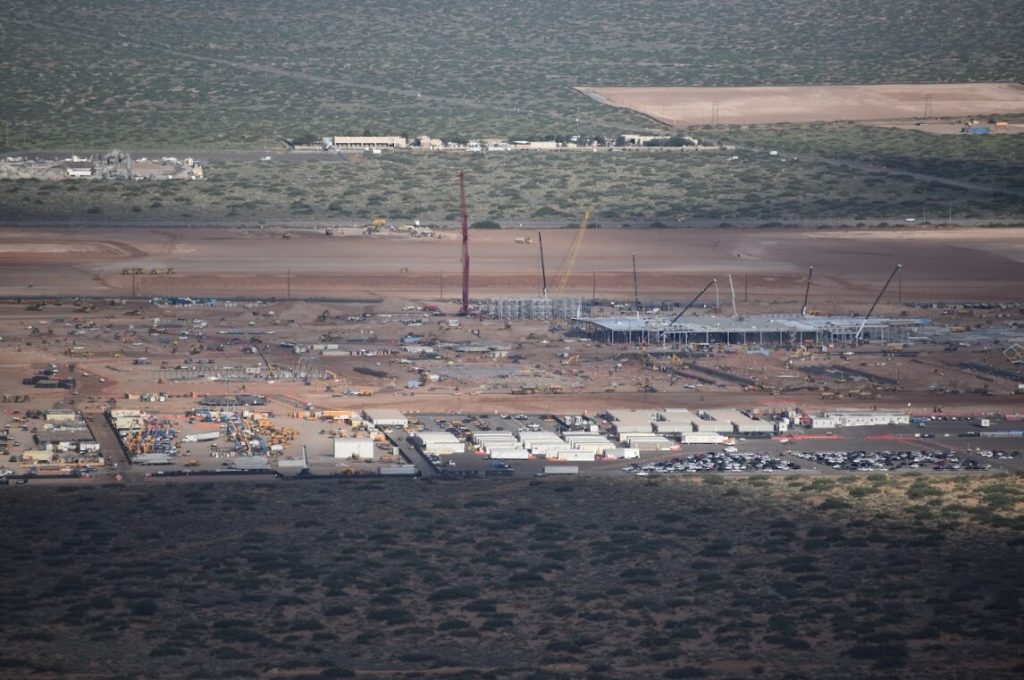
Aerial photos taken on June 26, 2026 show the massive scale of Project Jupiter, planned for use by Oracle and OpenAI. Photo by Alexa Reynaud for Food & Water Watch and Lighthawk.org / Used With Permission.
Commissioners then passed a complex agreement in September 2025 with just 3 weeks of public input. At the same time they authorized Commission Chairman Christopher Schaljo-Hernandez to sign the final legal agreements in secret.
During that time, the agreement ballooned from approximately 359 pages to 1,583 pages. It also included a small but important definition update on potable vs. non-potable water, which could make all the difference in a desert with limited water resources.
Signing off likely violated the state’s transparency laws that require public disclosure, according to the New Mexico Foundation for Open Government, which filed a lawsuit in early July 2026. There are also two pending lawsuits in process from the New Mexico Environmental Law Center, which has challenged the legitimacy of the project for similar reasons.
Former Cabinet Secretary Working On Both Sides of the AI Boom Raises Questions
While Oracle’s legal maneuvers are a main focus, there are also open questions about lobbying, cozy relationships, and walls between the public vs. private sector.
Alicia Keyes is the former NM Economic Development Secretary who served from 2019-23 and left her post on June 29, 2023. Just over a year later, she created Apaluma, Inc, which is described as an AI intelligence company that “illuminates government data,” including AI-powered permitting, licensing, bill, and public request reviews. Keyes has identified herself as founder and CEO of Apaluma on the website and podcasts.
Keyes was listed as working on “government affairs” for Borderplex Digital around the time of the January 2025 announcement, but was quietly removed from the website within a couple of weeks.
From April – July 2025, Apaluma was added to contracts for “Project Velocity” totalling approximately $3.2M with the NM Environment Department (NMED), potentially at the request of her former colleague, Cabinet Secretary James Kenney, according to public records watchdog The Candle. In March 2026, The Candle published information on a no-bid contract worth $499,990 followed by one worth $977,354.
Project Velocity is described in contracts as a “‘front-end’ to the digitized unstructured content” from NMED and appears to be similar to a Large Language Model (LLM) like ChatGPT or Gemini that would scan and access millions of the agency’s records.
Throughout 2025 and into 2026, Keyes and Apaluma apparently continued to work closely with NMED, including on a case study video featuring Secretary Kenney and state officials that was posted on Youtube, embedded on the Apaluma website, and later deleted.
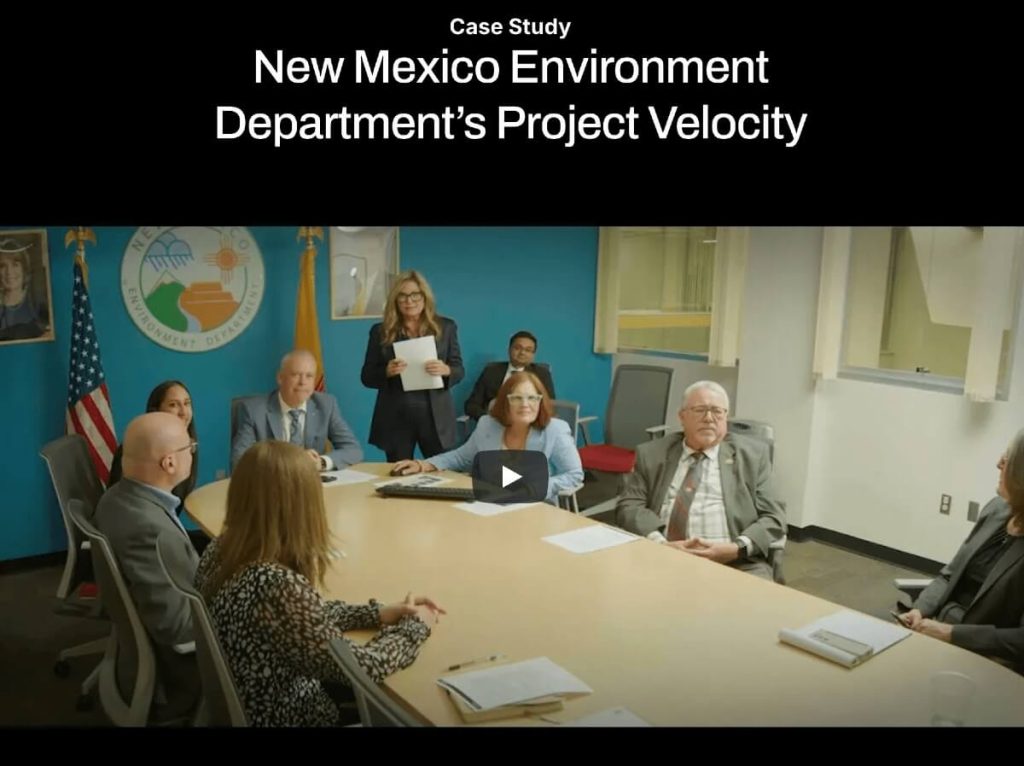
Screen capture image of the Apaluma website homepage from February 8, 2026, showing an embedded YouTube video.
At the same time, NMED proceeded with an air quality permit application for Project Jupiter. And NMED also held water quality hearings that included lobbyists for Project Jupiter, one of whom was listed on the Project Velocity contract alongside Keyes.
Those hearings could directly impact the project because there’s been conversation about using produced water (byproduct from oil & gas wells) for cooling data centers, as well as drilling for brackish water. Matthias Sayer, who was listed as a lobbyist for both Borderplex Digital and Apaluma in early 2025, spoke with Capital & Main for a story earlier this month to make that exact case.
On June 2, 2026, Keyes and Dr. Sydney Lienemann, presented a product demo at the Western Conference of Public Service Commissioners titled “One Platform, Four Agencies: Illuminating Government Data” that described using AI “to connect NMED, OSE [Office of the State Engineer], PRCe360 [Public Regulation Commission e-docket], and Secretary of State data.”
Lienemann is listed as a “strategic advisor” and served as NMED Deputy Secretary of Administration from 2023-24, and former DOE Deputy Assistant Secretary for Renewable Energy from 2024-25. She was also described as an advisor to Apaluma in materials for a November 2025 Energy Symposium at New Mexico Tech, an event at which Secretary Kenney was selected to be a keynote speaker.
It is not known what, if any, contracts or data agreements exist between Apaluma, Keyes, and the additional state departments.
Secret PR Campaigns, Paid Influencers, and Public Comment Controversy
Starting in January 2026, a secretive out of state company named Elevate New Mexico poured millions of dollars into paid advertising via TV, social media, and mail in support of Project Jupiter.
That ad purchase aligned with a public comment period for Project Jupiter’s original air quality permit, which caused significant public outcry due to the “microgrid loophole” and pollution from the use of gas turbines to power the data center.

Photo of an Elevate New Mexico mailer. Via Source New Mexico / Neeshia Macanowicz.
In April, the company was sued by the NM State Ethics Commission and stopped running ads shortly after. So far, no one has claimed responsibility for the company, however, messaging and creative bear a resemblance to Oracle’s Project Jupiter Together campaign that was launched not long afterward.
In early June 2026, multiple social media accounts in New Mexico reported being contacted by a marketing firm with a paid offer to promote Project Jupiter. The timeline aligned with a May 31 to July 6 comment period on the project’s air quality permit before the NM Environment Department.
The stated campaign goals were to “build trust” and “help increase positive comments” by discussing the positive benefits of the project and saying that the project’s fuel and water systems won’t impact the surrounding community.
The campaign received significant backlash on social media, including from local influencers who asked their fellow residents not to support it and pushed back on the company’s tactics. Many comments specifically called out Oracle for dividing New Mexicans by pouring cash into a state where people are already struggling.
Residents also described being approached by paid canvassers during the air permit public comment period, noting that they stated they were against the project but agreed to provide their email address for more information. They later received an email with a copy of a positive comment submitted in their name.
Several local elected officials also reported that positive comments were submitted in their name without consent. New Mexico’s Attorney General is now investigating those reports.
The air permit application received 17,000+ comments, over 10,000 more than the earlier air quality permit that was rescinded earlier in the year. Many of them appear to be automated in some form, with comment volume at times reaching as high as 175 comments per hour.
On July 1, staff in the NMED recommended a public hearing, which was subsequently approved by Cabinet Secretary Kenney. On July 7, Kenney then authorized a hearing officer, and gave Deputy Cabinet Secretary John Rhoderick authority “to make all final and dispositive decisions [on the permit].”
Entrepreneurial School Board President Looks For Opportunities
If current and former state officials appear to have entanglements with Project Jupiter, so, too, do some local elected leaders.
On June 26, 2026, a local activist group in Doña Ana County noticed that Christian Lira, the Gadsden Independent School District (ISD) board president, submitted a letter of support for Project Jupiter, matching the form letter that Oracle has on their Project Jupiter website.
Lira describes himself on a personal website as a “Trailblazer Entrepreneur” who works in cannabis consulting, and is currently the subject of a recall attempt by a local candidate for mayor of Sunland Park, NM.
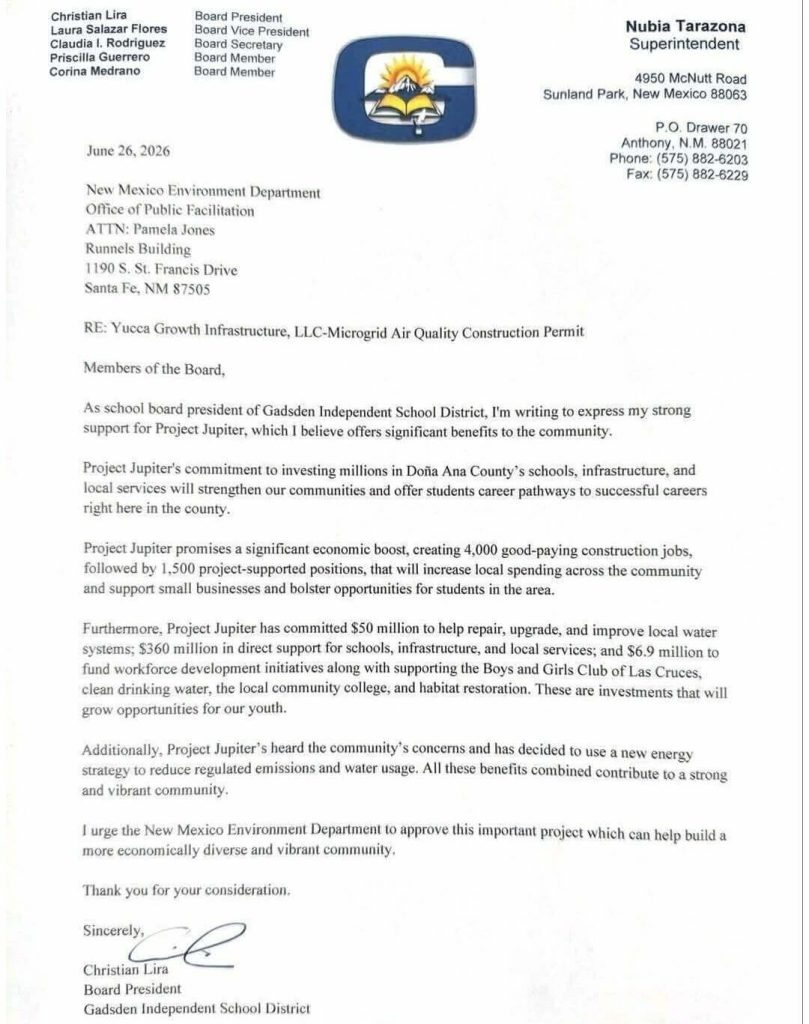
Photo of a letter from June 26, 2026 on Gadsden Independent School District letter head, signed by Board President Christian Lira.
Per state statute, the board president doesn’t have the authority to submit a letter on behalf of the board without a vote or open meeting and discussion with the public. This could potentially be considered an ethics or misuse of funds issue, according to information from the NM School Board Association (page 30).
Based on a review of the archive of agendas, minutes, and video recordings, there was no public discussion or vote going back to March that would have authorized the letter.
The only relevant conversation was at a May 21 meeting where Lira mentioned having a relationship with Oracle when another member asked “maybe you can have them build us a new school?”
It’s not clear how deep the relationship is between board members / the district and Oracle, but the company appears to have funded Gadsden ISD on at least two occasions in 2026. Those led to a public thank you on social media and local news coverage. The district has schools within just a few miles of the development.
Taking A Pause: More Transparency Is Needed
In one way or another we’re all being impacted by these massive projects…
Hiding tradeoffs, negotiating secret agreements, etc. make it harder to have a real conversation. That’s a big part of why ProgressNow NM put out a report in late June on what’s involved, not just with Project Jupiter but with any hyperscale data center being considered by a community.
We also provided examples of policy options that both state and local leaders can consider, using resources like the North Star Data Center Policy Toolkit.
Truthfully, we don’t know everything that’s needed here, but more transparency clearly has to be part of the path forward along with closing loopholes in our existing state law.
Whatever happens, our team will keep tracking developments, and keep New Mexicans posted.