
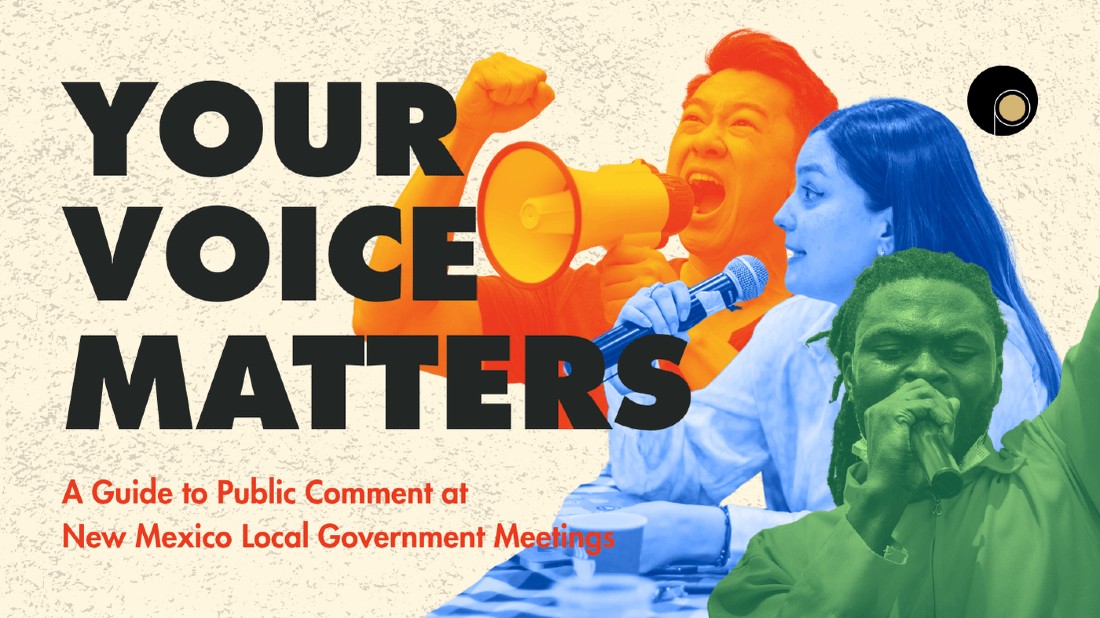
Your Voice Matters: A Guide to Public Comment at New Mexico Local Government Meetings
Public comment can feel intimidating. But here's the truth: Your story holds power.
When you speak, you're not just one voice—you're speaking for your family, your block, your community.
In New Mexico, we look out for each other. Neighbors show up for neighbors. When you give public comment, you're ensuring everyone has a seat at the table in decisions that affect safe communities, good schools, and good jobs for our families.
What to Expect at Local Government Meetings
While each local government meeting is different, here are some basics you can expect:
- Agendas are published ahead of time – For example, Las Cruces City Council usually publishes an agenda on Thursday afternoons for Monday meetings.
- There is a sign-up process for public comment – Albuquerque City Council requires sign up by 4pm the day of the meeting, while APS School Board comment sign-up starts at 8am the day of the meeting until full.
- There are time limits – Most meetings have a 2-3 minute time limit, which is reduced if there are a large number of speakers.
- Meetings and information sharing vary – Visit your local government website or call/email them with any questions. You can also view the NM Attorney General's Open Meetings Act compliance guide, which outlines the legal requirements for local governments e.g. posting agendas 72 hours ahead of time.
Before You Speak: Preparation Checklist
✓ Read the meeting agenda and identify relevant items
✓ Write out your comment and time yourself (aim for 2-3 minutes)
✓ Practice speaking slowly and clearly
✓ Know your specific "ask"—what action do you want them to take?
✓ Plan follow-up: get contact info for officials/staff to continue the conversation
Pro tip: Create both a 2-minute and 1-minute version of your comment. You can also use an Estimated Reading Time Tool to check your comment length.
Need some practice? Download our NM Public Comment Worksheet to help you craft and refine your comment before the meeting.
Crafting Your Public Comment: A Simple Structure
Opening (Choose One)
- "My name is [Name], and I'm a resident of [Neighborhood/City]. I'm here today because [issue] affects my family and our community"
- "Good evening, I'm [Name] from [City/Town]. As a [parent/teacher/small business owner/neighbor], I care deeply about [safe communities/good schools/good jobs] for our families"
- "My name is [Name], and I've lived in [City] for [X] years. I'm here to speak about [agenda item] because it impacts our ability to build a successful life for our family"
Bridge to Personal Story
- "I want to share a story about why this matters to me and my neighbors…"
- "This isn't just about policy—it's about real people in our community. Let me tell you about…"
Three Core Points
- Who You Are & Connection to Issue: "I'm a [parent/worker/resident] in [District], and this issue affects my family because…"
- The Problem: "Right now, [describe the problem with specific impact on families/communities]…"
- The Solution & Ask: "I'm asking the [Council/Board/Commission] to [specific action] because it will create [safer community/good jobs/affordable housing] for all of us"
Closing
- "Thank you for your time. I'm asking for your vote in favor of [measure] to build a safer, stronger [City] for all of our families"
- "I'm not just speaking for myself—I'm asking you to listen to the voices of [parents/workers/neighbors] who deserve a seat at the table”
Telling a Good Story: Connect On Shared Values
Each person's story is unique. Using your voice takes practice, but here are some story elements that resonate with New Mexico voters and officials:
Use the Framework:
- Start with common ground: "We all want our children to have good schools and safe streets to walk on"
- Name the problem: "But right now, [specific problem] is making it harder for families like mine to thrive—[give concrete example with impact]"
- Return to shared vision: "We can make [City] work for everyone if we're willing to ensure all of our voices are part of the decision-making process"
Story Types That Work
- Personal hardship/overcoming: Your family's experience with housing insecurity, healthcare access, or economic challenges
- Family narratives: Stories of parents working multiple jobs, children affected by school policies, seniors struggling with costs, multigenerational households facing challenges together
- Community transformation stories: "When our neighborhood came together to [action], we saw [positive result]—this shows what's possible when we invest in our communities.”
After You Speak: Follow-Up Actions
✓ Send a thank-you email to officials who heard your comment
✓ Share more detailed information (if requested)
✓ Connect with other community members who spoke
✓ Track the decision and vote on your issue
✓ Continue engagement through letters, calls, and future meetings
Accessibility & Accommodation
- Check with your local government to request interpreters or disability accommodations
- Remote participation options are often available for those who can't attend in person
- You can also submit written comments if you can't speak at the meeting
Together, We Build a New Mexico That Works for Everyone
New Mexicans show up for their neighbors. We support small businesses. We know our diversity, tradition, and values set our state apart. When you give public comment, you're ensuring government reflects our basic value of respect for all different people and communities.
Your voice is power. Your story matters. Show up.