

This is the fourth post in a five-part series on “The Hidden Tax: New Mexico’s Energy Crisis & Path Forward.” Read Part 1 on household budgets, Part 2 on seniors and local businesses, Part 3 on oil money dependence, and Part 5 on infrastructure policy.
Imagine being a second generation oil worker in San Juan County ten years ago when the Permian boom really kicked off, effectively killing hundreds of jobs in one part of New Mexico as hundreds flocked southeast. Now imagine you want to put your skills to work in the emerging market of geothermal energy which requires many of the same kinds of drilling and site-preperation jobs, but you don’t know where to find that training. And we’ve all seen legislators in Santa Fe navigate the tightrope of arguing for moving away from oil and gas production as means to revenue, but doing so knowing that over 30% of the funding for any bill they do pass will likely come from those industries. That’s the precarious energy trap New Mexico currently faces.
As the Trump-caused energy crisis continues to drive oil prices into roller coaster swings, it’s accelerating a counterintuitive trend: the global rush to renewable energy. Far from reinforcing fossil fuel dominance, this energy shock is proving exactly why nations need energy independence.
The Global Acceleration
According to the World Economic Forum, global energy investment in 2025 passed $3.3 trillion, with $2.2 trillion flowing into clean energy technologies; everything from solar and wind to grids, storage, and electric vehicles. That’s two-thirds of every dollar spent on energy already going to cleaner options.
The driver isn’t just climate ambition anymore, it’s security and economics.
- Energy Security: Nations are reducing exposure to volatile global oil markets and geopolitical chokepoints like the Strait of Hormuz
- Resilience: Distributed renewable systems are less vulnerable to single points of failure than centralized fossil fuel infrastructure
- Competition: Countries are racing to build clean energy manufacturing capacity, not just installations, to capture economic advantage
The International Energy Agency projects solar PV investment alone will reach $450 billion in 2025, making it the largest single item in global energy investment. The message is clear: the future of energy security is renewable.
New Mexico’s Energy Transition Act
New Mexico positioned itself as a leader in this transition with the 2019 Energy Transition Act (ETA), which mandates:
- 50% renewable energy by 2030 for investor-owned utilities
- 80% renewable energy by 2040
- 100% zero-carbon resources by 2045
The state has continued building on this framework. During the 2025 legislative session, lawmakers passed SB48, establishing a $210 million Community Benefit Fund to support clean energy, clean transportation, and methane reduction projects around the state.
Governor Lujan Grisham’s administration has enacted a series of laws addressing the largest emissions sources: electricity, transportation, and oil and gas. New Mexico is growing as a subnational climate leader, serving as a model for transitioning an economy largely dependent on legacy energy production to one more diversified and cleaner.
The Fiscal Paradox: Funding Transition with Extraction Revenue
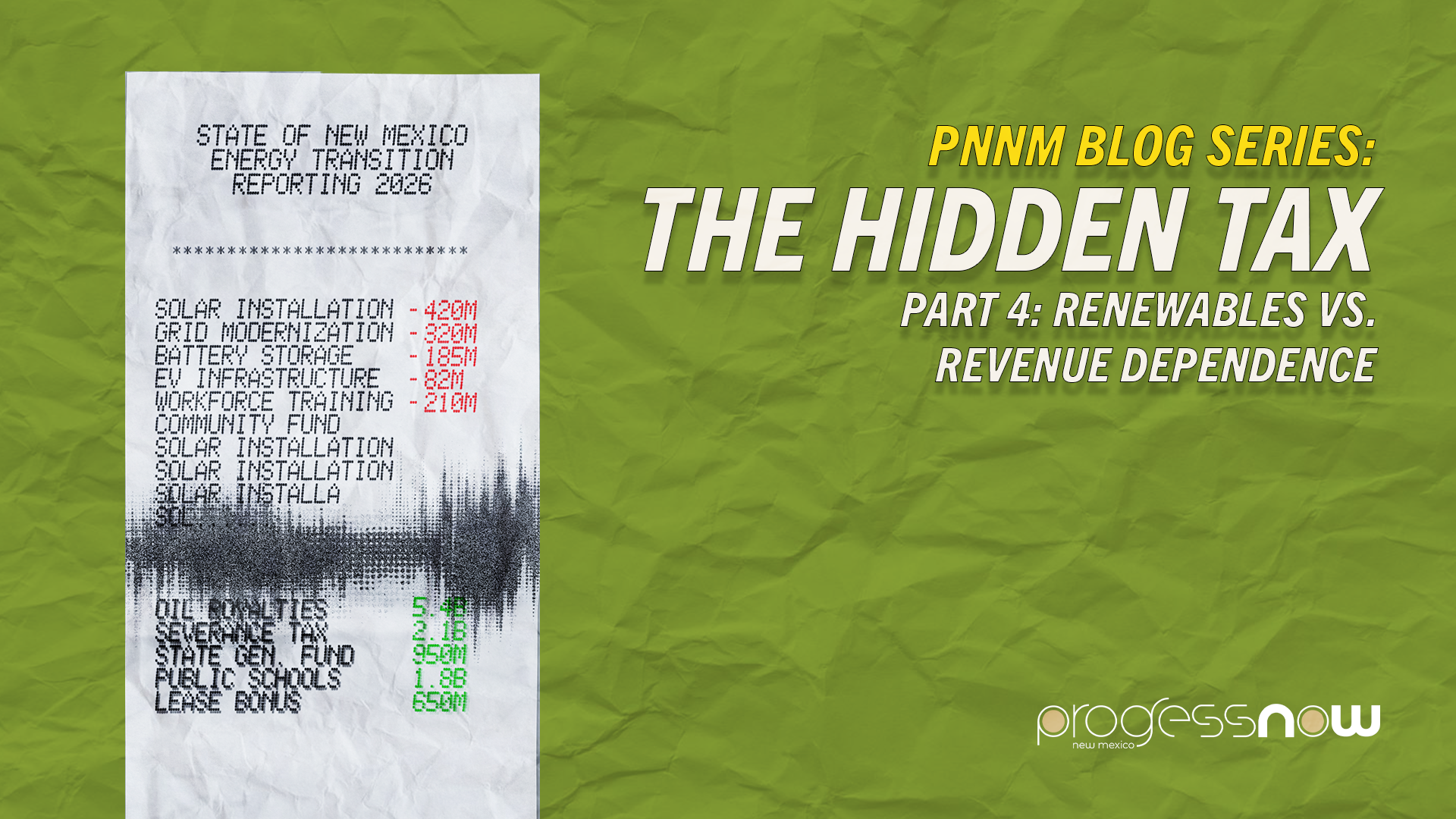
But here lies New Mexico’s central paradox: the state is trying to transition *away* from oil and gas while simultaneously depending on it for roughly 35% of its state budget.
This creates a precarious fiscal situation:
The Dependence:
- Oil and gas revenues account for over one-third of all state funding, supporting education, healthcare, and infrastructure
- In FY2024 alone, the industry generated $15.2 billion for New Mexico
- As we’ve reported before: “When global prices spike, we see short-term budget surpluses—but those same spikes accelerate the global shift away from oil”
The Risk:
- The IEEFA warned in a landmark report that New Mexico’s “risky reliance on oil revenue” threatens long-term fiscal health
- Oil prices are volatile—plummeting to negative numbers in 2020 before climbing to profitable ranges, creating boom-bust budget cycles
- High oil prices create strong incentives for electric vehicle adoption and renewable energy expansion, potentially reducing long-term demand
The Diversification Challenge
The New Mexico Economic Development Department’s strategic plan calls for reducing reliance on oil and gas by growing nine target industries: aerospace, biosciences, cybersecurity, film, outdoor recreation, sustainable agriculture, intelligent manufacturing, global trade, and green energy.
From 2010 to 2020:
- Aerospace generated almost half of all new jobs (roughly 4,000)
- Cybersecurity added about 2,500 jobs (the state’s fastest-growing target industry)
- Sustainable and green energy took third place with roughly 1,600 jobs
But the state acknowledges this isn’t enough yet. The Economic Development Department warns: “New Mexico’s lack of industrial diversification has resulted in volatile economic cycles in which employment and the state’s ability to fund public services are highly dependent on oil and gas prices as well as federal policy decisions.”
The Irony: High Prices Accelerate the Exit
Here’s the cruel irony for New Mexico policymakers: the very oil price spikes that fill state coffers today are accelerating the global transition away from oil tomorrow.
When gasoline hits $5 per gallon:
- Consumers buy electric vehicles faster
- Businesses invest in energy efficiency
- Governments fast-track renewable permitting
- Investors shift capital from exploration to clean tech
The World Economic Forum notes that 2026 is shaping up as an “execution test” where countries compete for advantage in a “messy, politicized energy landscape.” Projects that move fastest will combine resilience with compelling local stories: cleaner air, stable bills, visible economic benefits.
For New Mexico, this means the window to diversify is narrowing. The state must use revenues generated by current high oil prices—and available federal funds—to deliver on its diversification commitments before demand peaks and declines.
What’s at Stake
If New Mexico doesn’t successfully navigate this transition:
- Budget volatility will worsen as oil markets fluctuate and long-term demand uncertain
- Public services (education, healthcare, infrastructure) face funding gaps when oil revenues decline
- Workers in extraction industries need robust retraining and upskilling programs to transition to new industries
- Communities in the San Juan Basin and southeast New Mexico risk economic decline without proactive diversification
As the IEEFA report concluded: “By realigning its economic development policy to diversify its economic base and pivot from overreliance on oil and gas production, New Mexico can chart a path toward economic stability.”
But that path requires honest acknowledgment of the paradox: you can’t fund a post-oil future indefinitely with oil money. The state’s Energy Transition Act sets ambitious clean energy goals, but achieving them requires building a tax base and economy that don’t depend on the very industry being transitioned away from.
In the context of the current energy crisis, this isn’t just environmental policy, it’s fiscal survival.
Tying it all Together
In the previous entries to this series we’ve looked at how global oil prices are affecting our families and communities in both direct and indirect ways, unfortunately creating tighter budgets and higher prices for everyone. One of the many benefits of renewable energy in both short and long term scenarios is cheaper energy at the consumer level; basically, it’s more affordable for us to purchase power from solar, wind, and geothermal RIGHT NOW and it will only get cheaper, especially compared to the price of fossil fuel-produced energy over time.
New Mexico has made some strides to bring more renewable energy to consumers through the ETA and other policies like expanded Community Solar projects, but just like with oil and gas we’re already seeing a lot of focus on building out renewable energy infrastructure only for the final product, the actual electrons, shipped out of state through projects like SunZia. New Mexico needs to prioritize renewable energy projects both for workers AND consumers, and we need to do it sooner rather than later.
What’s Next in This Series
The crisis extends beyond transition economics. In Part 5 (our final installment), we’ll look at why gas tax holidays are a dangerous fix that makes the infrastructure problem worse—and what policies would actually help New Mexico families.
What You Can Do
- Support workforce transition: Advocate for retraining programs that help oil workers move into renewable energy and other growing industries
- Demand diversification: Push policymakers to invest oil revenues in non-extraction industries like aerospace, cybersecurity, and green energy
- Stay informed: Follow the Energy Transition Act implementation and hold officials accountable to 2030/2045 goals
- Share your story: Tell policymakers how the energy transition is affecting your job, business, or community
Bottom Line: New Mexico’s Energy Transition Act sets ambitious clean energy goals, but achieving them requires building a tax base and economy that don’t depend on the very industry being transitioned away from. The current energy crisis proves the point: energy security means renewable independence, not fossil fuel dependence. For New Mexico, the path forward requires using today’s oil revenues to fund tomorrow’s post-oil economy—before the window closes.