
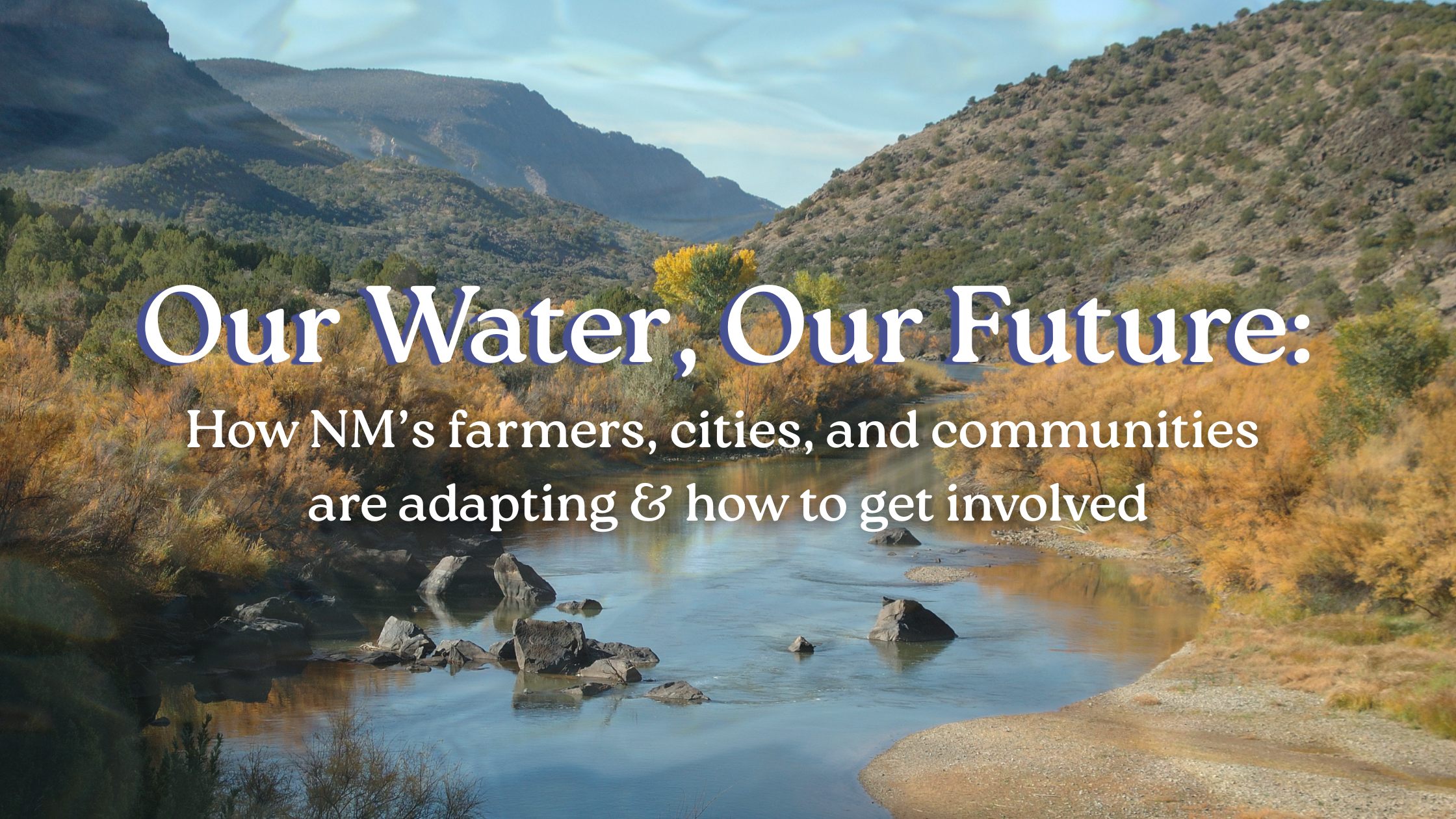

Picture a small farm near the Rio Grande in Socorro County. For generations the family there has grown chile and corn. Each spring, water arrives from a long journey that started out as snowmelt high up in the mountains.
Water means life for crops, for community, and for the wildlife that depends on the river. But this year, the riverbed is staying dry much longer than usual.
Snowpack was extremely low, and that means their irrigation water is likely to come late. It may even run out instead of lasting through October like it used to. And families in Socorro are not alone, farmers across New Mexico are facing the same reality.
Sign up for our email newsletter to get the latest blogs, news, and policy updates from ProgressNow NM
The Challenge We Face
New Mexico is in a drought emergency, with all 33 counties recently declared as disaster areas. Our reservoirs are at just 13% of capacity. Groundwater is being pumped faster than it can refill.
At the same time, new demands are emerging. Massive AI data centers are proposed or already in construction in multiple areas of New Mexico. These facilities can use up to 5 million gallons of water per day, as much as a town of 50,000 people.
And while companies often tout the advantages of “closed loop systems” that use a one-time fill up, there’s some misdirection around water use. Often, the numbers they share publicly refer to direct cooling for servers and not the water required for electricity generation.
That difference came into focus over the last several months with Project Jupiter in Dona Ana County. Developers behind the project spent millions of dollars on TV ads, social media, and PR to talk about minimal water use on site (potable), even as they still have a contract with a local sod farm for up to 1M gallons/day (non-potable).
Yet, a recent scientific study found that 52% of all water use in the Rio Grande basin is unsustainable. In New Mexico’s portion of the basin, 85% of direct water consumption is unsustainable. We’re using water faster than nature can replenish it.
This isn’t just about farmers. It’s about all of us. The Rio Grande provides water for 4 million people in the U.S. portion of the basin. It supports ecosystems, wildlife, and our unique New Mexico way of life.
Signs of Hope
Here’s the good news: New Mexicans are stepping up.
Cities across the region are leading on conservation – Albuquerque’s population grew by 40% while its water use declined by 17%. El Paso’s population grew by 36% while water use dropped 6%. This proves that growth and conservation can go together.
Communities are organizing – In Socorro County, residents packed town halls to speak about a proposed AI project there, citing land, water, and resource concerns. Socorro County Commissioners responded by unanimously passing a 1 year moratorium to give communities time to develop proper safeguards. Santa Fe passed an 18 month moratorium not long after.
And State Reps. Micaela Lara Cadena (D-Mesilla) and Angelica Rubio (D-Las Cruces) are leading efforts for a statewide pause on data centers until there are real guardrails in place, including requiring real transparency on water/electricity use (not just TV ads with nice promises).
Farmers are adapting – Voluntary water conservation programs are paying farmers to fallow land temporarily. Researchers are working on crop mixes that use less water. The USDA just declared a drought emergency, making farmers eligible for low-interest emergency loans up to $500,000 to help them weather this crisis.
How You Can Get Involved
This is where you come in. Our water future isn’t something that happens to us – it’s something we build together.
1. Speak up. Public comment is open through August 31st on draft guidelines for the state’s Water Security Planning Act. Learn more and submit a comment!
2. Speak up. Attend your local water planning meetings. And when large water users propose projects in your community, ask questions. How much water will they use? Where will it come from? What happens when the project ends? Demand public hearings, transparency, and legally enforceable agreements.
3. Stay informed. Follow local news about water issues – we recommend subscribing to/supporting YUCCA and Western Resource Advocates. Share what you learn with neighbors. Water policy can seem complicated, but it affects all of us.
Generations of New Mexicans have found ways to adapt to our arid landscape. We’ve built acequias, cultivated drought-resistant crops, and created communities that thrive in the high desert.
We can do this. But we need to do it together – with farmers and city dwellers, rural and urban communities, all working at the same table.
The decisions we make in the next few years will shape New Mexico for generations. Let’s make sure those decisions reflect our values: fairness, sustainability, and our communities having a voice.
Our water is precious. Our communities are strong. And our future is in our hands.