
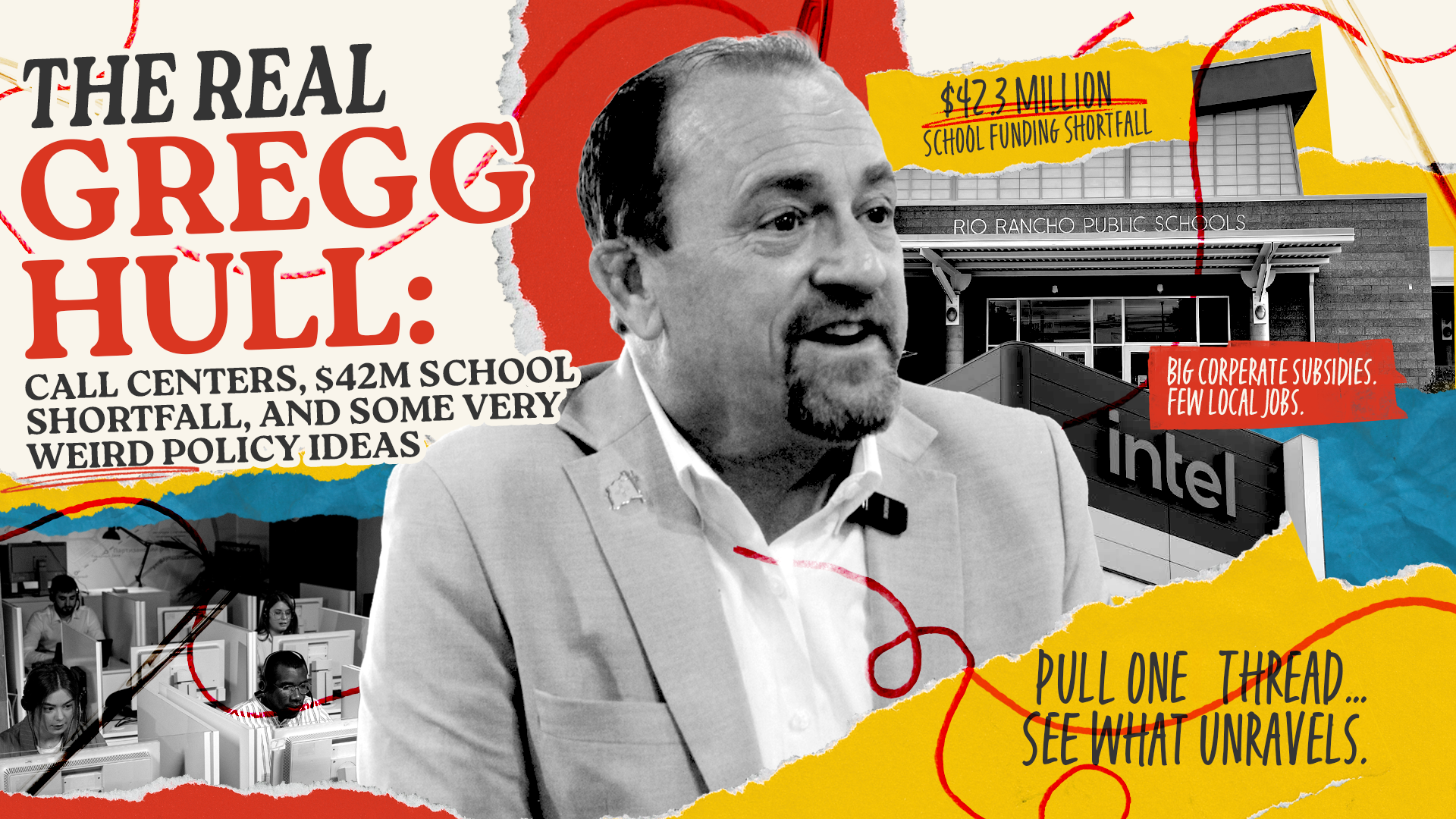

If you’ve heard anything about New Mexico politics lately, you probably remember a version of this pitch: Gregg Hull is a get-it-done Republican who turned around a sleepy suburb and now he’s ready to do the same for the whole state as governor.
The problem is, once you start pulling on that thread, it unravels fast – into the story of a mayor who benefited from a unique set of circumstances, who’s been handing out corporate subsidies with both hands, and whose actual policy ideas range from weird to genuinely dangerous.
Who Is Gregg Hull?
Hull is the longest-serving mayor in Rio Rancho history, holding office from 2014 until earlier this year. He’s a former small businessman who came up in Oklahoma, moved to New Mexico more than 35 years ago, and built his political brand as a “pro-business” leader.
He announced his run for governor in April 2025, became the clear Republican frontrunner at the GOP pre-primary convention in Ruidoso in March 2026, and won the primary in June. He’s now the Republican nominee, facing Democrat Deb Haaland this fall.
Hull has consistently pitched himself as a moderate who gets results – doubling Rio Rancho’s police budget, refusing to raise the city’s sales tax over 12 years, and overseeing the city’s growth from roughly 93,000 residents to nearly 113,000. He has also explicitly rejected the MAGA label.
That last bit matters, because New Mexicans who care about their families and their communities but don’t fit neatly into either partisan corner are the kind of audience Hull is trying to win.
But before any of us take his “I’m a different kind of Republican” pitch at face value, it helps to look at the actual record.
Why Hull Has Flown Under the Radar
Here’s the part most people miss: Rio Rancho isn’t Albuquerque. It isn’t Santa Fe. It isn’t Las Cruces, Hobbs, or Gallup. For most of Hull’s tenure, Rio Rancho has been a relatively isolated, fast-growing suburb whose biggest economic story – Intel – predates Hull by decades.
That isolation gave him cover. When other New Mexico cities were dealing with a slow recovery from the pandemic, struggles with violent crime, a worsening housing crisis, and tight budgets, Rio Rancho kept growing, kept hiring cops, and kept its taxes flat. To a casual observer, that’s a mayor doing everything right.
But look a little closer and you start to see what was actually happening:
Hull inherited Intel’s massive Rio Rancho campus, and he kept subsidizing it anyway. A July 2026 Good Jobs First report pointed out that between 2017 and 2025, Intel paid Rio Rancho Public Schools just $1.1 million in PILOT payments – payments in lieu of taxes that are supposed to make up for the company’s property tax exemption. Had Intel actually paid property taxes, the district would have received an estimated $43.4 million. That $42.3 million shortfall is more than enough to build a brand-new high school and equip it with computers for every student.
Intel’s local workforce has stayed about the same under Hull’s watch. Hull told an Albuquerque Journal town hall in May 2026 that Rio Rancho’s Intel plant currently has around 3,000 employees, down from a peak of 3,500. In 2014, when Hull became mayor, Intel reported having 2,800 employees. In other words: there’s been little growth in the number of good-paying jobs at the city’s biggest employer, even as the city keeps handing the company tax breaks.
Even the federal government noticed. In 2024, Intel was awarded $500 million from the federal CHIPS and Science Act to expand the Rio Rancho campus, even though the company had laid off more than 200 workers at the site the previous year.
That’s not a record of “growing the economy.” That’s a record of asking working families and kids in classrooms to subsidize a corporation that was shedding the very jobs the subsidies were supposed to protect.
The Pro-Business Playbook: Subsidize First, Ask Questions Later
Hull’s tenure in Rio Rancho has also been defined by an aggressive – and largely uncritical – embrace of economic development subsidies. Two recent examples show what that playbook looks like in practice.
Project Ranger / Castelion
The biggest economic development story in Sandoval County right now is Castelion’s Project Ranger, a 1,000-acre solid rocket motor manufacturing campus planned just 2.9 miles west of Rio Rancho’s city limits. The company has promised more than 300 high-paying jobs (averaging $100,000) and $650 million in economic output over the next decade – and the state, Sandoval County, and Rio Rancho were quick to put up the public money.
The package: $5 million from the state, $4 million from Sandoval County, and up to $1 million from Rio Rancho under the Local Economic Development Act (LEDA), plus $125 million in industrial revenue bonds approved by Sandoval County. Local officials said the agreement includes clawbacks if Castelion doesn’t meet job creation and safety benchmarks.
That sounds reasonable – until you read the details. An investigation by The Sandoval Signpost found that the site sits within five miles of nearly 6,000 buildings, including homes, two elementary schools, two fire stations, and nine parks. Technical safety documents reviewed by the Sandoval Signpost show that emergency explosion scenarios could affect structures up to five miles away. Hundreds of residents packed community meetings in October and December 2025 to raise concerns about explosive storage, dust, groundwater, traffic, and plume impacts from a facility fire. Studies on some of those concerns are still ongoing.
And there are very real signs the deal wasn’t handled responsibly: Rio Rancho and Sandoval County openly clashed in late 2025 and early 2026 over which agency was actually responsible for fire and emergency response at the facility. The Rio Rancho City Council required a memorandum of understanding before releasing city funds, after Rio Rancho’s Fire Chief raised concerns about the facility’s high-hazard classification.
This is what “pro-business” looks like in Hull’s world: rush the deal, take the corporate promise at face value, fight about who’s on the hook when things go wrong, and let the hardworking families near the site absorb the safety risk.
The Call Center Pattern
Rio Rancho has become a magnet for call centers and customer service operations – a quick Indeed or ZipRecruiter search turns up dozens of openings, mostly paying in the $14 to $20 an hour range.
Many of these jobs arrive with state and local incentive packages, including LEDA funding and the state’s Job Training Incentive Program (JTIP) reimbursements for wages. JTIP records show low-wage reimbursements concentrated in places like Rio Rancho.
Rio Rancho residents will recall call centers for Victoria’s Secret, JC Penney, and Sprint that were shut down. More recently, Safelite received nearly $4 million in JTIP and LEDA funds in 2017. It, too, went the way of previous call centers, ramping up to employ almost 900 people before shuttering. All came and went, with little lasting impact provided in return.
Hull’s economic development strategy has consistently been: take whatever jobs a corporate recruiter brings, and don’t ask too many questions about wages, career paths, or whether the city is getting a fair return on its investment.
When the Sandoval Economic Alliance – the private nonprofit that Rio Rancho has been paying $75,000 a year to recruit businesses – came up for review during the FY27 budget process in May 2026, one city councilor even questioned whether the city was just “giving them money to pay their bills.” Internal debates about how much of SEA’s recruiting efforts actually translate into lasting, family-supporting jobs in the community are an open question.
The Weird, Extreme, and Poorly Thought Out Stuff
If the economic development record were the only story, this would be a tough-but-fair critique of an incumbent-style Republican. But the more Hull talks on the campaign trail, the more his actual policy ideas raise eyebrows – even by the standards of people who normally vote Republican.
Eliminating the personal income tax. Hull has proposed phasing out New Mexico’s personal income tax entirely. Independent analysis puts the cost at roughly $2.2 billion in lost revenue – money that currently funds schools, health care, public safety, and infrastructure. It would effectively give a massive tax break to the wealthiest New Mexicans while shifting the burden onto working families through higher gross receipts taxes and property taxes. That’s less of a “pro-business” policy and more of a “pro-billionaires” policy, paid for by everyone else.
Produced water for data centers. During the 2026 primary, Hull suggested using “produced water” – i.e., the toxic wastewater that comes out of oil and gas wells – to cool data centers like Oracle’s Project Jupiter. New Mexicans who live anywhere near the oil patch know exactly how problematic that is, including the risks to our already-struggling aquifers, rivers, and lakes, not to mention the air and land near our children’s schools.
Rejected a pause/ban on AI data centers. Hull came out against a moratorium or ban on new AI data centers, saying it “sends the wrong signal at exactly the moment we should be competing for these investments.” That’s a giveaway to the largest, most water-hungry corporate interests operating in our state – at the very moment communities are waking up to the costs.
“Comfortable in a position of public dependency.” On a Santa Fe New Mexican podcast in September 2026, Hull said the state has created safety nets that let people “be comfortable in a position of public dependency.” That’s a remarkable thing for a public official to say out loud about his fellow New Mexicans accessing SNAP food benefits and healthcare in hard times – and it tells you a lot about how he sees the families he’s supposedly running to serve.
Lag on child support. Public reporting from the Santa Fe New Mexican has documented that Hull fell behind on his child support obligations earlier in his life. Whatever the circumstances, it’s the kind of personal responsibility story that a candidate who talks constantly about “personal responsibility” ought to be willing to talk about openly.
Close ties to Trump/MAGA World. Hull called the possibility of a Trump endorsement “a pretty cool thing” and met with Trump in 2019. Under his leadership, Rio Rancho declined to charge the Trump campaign $240,000 in public safety costs for his 2019 campaign rally. Hull has also received thousands of dollars from wealthy donors who backed Trump.
The extremist running mate. There’s also Hull’s running mate, David Gallegos, who has compared abortion care to the Holocaust, called New Mexico “the abortion capital of the world,” and pushed unsubstantiated claims that abortion access increases human trafficking. In 2021, Gallegos also sponsored Senate legislation to explore giving up part of southeastern New Mexico to Texas. That is the team Hull will lean on to help him run New Mexico if he’s elected.
The Takeaway
Gregg Hull’s pitch to New Mexico is that he can take what he did in Rio Rancho and scale it up. That’s a pitch worth considering – and dismissing once you’ve actually looked at the record.
What he did in Rio Rancho was to inherit a fast-growing suburb with a legacy Intel campus, refuse to raise the local sales tax, keep handing out corporate subsidies, and accumulate a series of campaign ideas that would dramatically shift the tax burden from the wealthy to working families.
And his whole “I’m not a MAGA Republican” thing doesn’t really fly either. Hull said in August that he’s already reached out to Texas Governor Greg Abbot to talk about stopping access to abortion care in New Mexico. Texas state law currently bans abortion, even in extreme cases such as incest or rape.
New Mexico’s families don’t need another politician who mistakes corporate handouts for economic development, or who treats the safety net as something to be ashamed of. And we definitely don’t need a governor who seeks to interfere in decisions that belong to an individual and their healthcare team.
We deserve a governor who will actually invest in our schools, hold corporations accountable for the public dollars they receive, and make sure every community – not just the bedroom suburbs – gets a fair shot. That’s the choice in front of us this November.