

If it feels like New Mexico is ground zero for wealthy corporations testing ways to profit from AI, that’s probably because it’s true.
The most visible example is Project Jupiter in Doña Ana County, with Oracle pouring tens of millions of dollars into shaping public perception on a massive AI data center complex.
So far, those efforts include direct cash payments, divisive tactics around job creation vs. impacts on land, air, and water, and paid social media, TV ads, and influencer campaigns.
But what about the AI apps, platforms, and tools that aim to pour data into massive data centers?
We took a closer look and spoke with community advocates about one of the most controversial uses of AI: government surveillance.
It’s a broad, and fast growing, category that now includes automated license plate readers (ALPRs), drones, audio/video recording devices, and AI search software.
➡️ Sign up for our email newsletter to get the latest info from ProgressNow NM
Managing your “flock” in real time
By now, most people recognize the name Flock Safety – the company has raised over $1B from investors and currently holds contracts with local governments like Alamogordo and Las Cruces.
Flock had three contracts with Bernalillo County until Sheriff John Allen, who has expressed safety/privacy concerns, announced plans to end them this week.
Lesser known companies like Axon, Motorola, Shotspotter, Genetec, Vigilant, etc. are also involved in some form of audio, video, and AI enabled hardware and software in cities/cities across the state.
For example, a 2022 case study from Genetec describes how Albuquerque police use multiple products. Shortly after that case study was released, Police Magazine profiled how the city’s surveillance technology works in practice.
It all feeds into what the city calls a “Real Time Crime Center” (RTCC) which includes a network of live cameras, drones and gunshot detection devices that extend across the city and even onto Albuquerque Public Schools campuses.

The RTCC, according to Mayor Tim Keller, went from 100 cameras at the beginning of his tenure to 10,000+ in 2023. That number is likely even higher today because it includes homeowners and private businesses who can sign up to offer camera access to the police.
Last Fall, Las Cruces launched their own RTCC, which appears to mimic Albuquerque’s model. Jeremy Story, the police chief there, has fully embraced surveillance tech and Flock Safety in particular – we recently wrote about how LCPD installed pan/tilt/zoom cameras that can be controlled remotely to follow people and vehicles, and zoom in on faces and license plates in real time.
The Inevitability Narrative (Isn’t Inevitable)
After two decades of sales pitches about how surveillance is the primary way to create public safety, tech companies are seeing profits skyrocket, even as the costs of unchecked surveillance expand, too.
And they have Silicon Valley to thank, in part, because almost no one does inevitability – part of what’s often referred to as narrative positioning or strategic narrative – better than Big Tech. As evidenced by Flock’s over $1B in investor backing, that includes deep pockets and a willingness to “move fast and break things,” no matter the cost.

With that in mind, I got in touch with community advocates in Albuquerque and Taos so I could better understand how the “more surveillance, more profits” model is impacting New Mexicans on a daily basis.
“No one should have their privacy violated by default”
Joaquin Montoya works at a local sign shop in Albuquerque by day. Last year, Montoya started reading in his spare time about how the “more surveillance, more profits model” had spread across the US, and thinking about its impact on local residents.
Montoya isn’t a privacy expert by any stretch of the imagination. He remembers watching TV shows and movies like Enemy of the State and thinking how far off they felt. That view quickly shifted when he learned what was happening in his hometown, as he shared in a recent interview:
I had been reading about Flock’s cameras and AI during 2025, and that got me wondering ‘is this happening in Albuquerque…as I researched, I had the realization that not only was the answer yes, but we’ve built a massive high tech dragnet system without a single public vote, public hearing, or serious oversight.
His first stop was to contact City Councilor Dan Champine, who represents District 8, where Montoya’s family lives. Champine, a former APD officer who retired in 2023, seemed uninterested in addressing concerns about Flock and other surveillance tech the city employs.
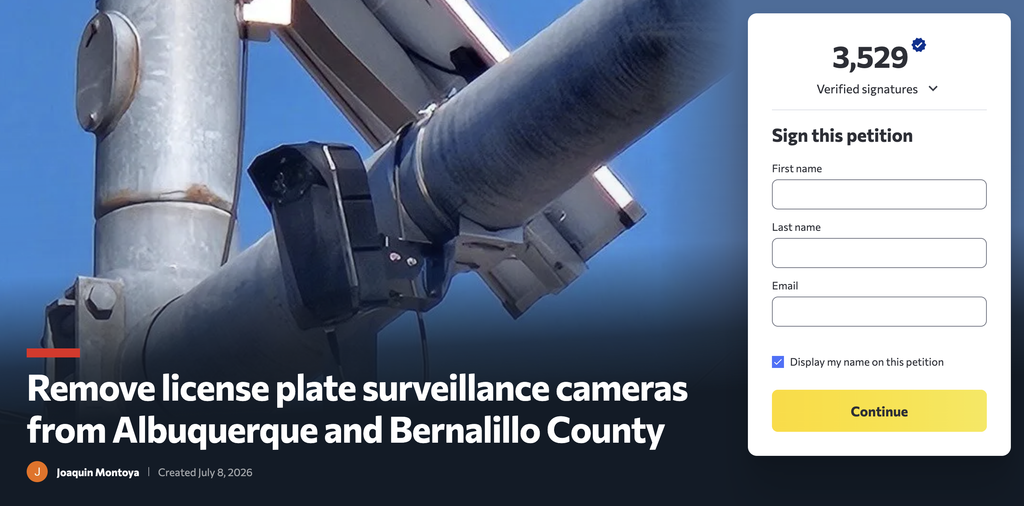
But Montoya is persistent, so he submitted a public records request to Bernalillo County, reached out to Senator Harold Pope, the ACLU of New Mexico, and other leaders and organizations to learn more about efforts at the state level, like SB 41 The Driver Privacy and Safety Act.
He also wanted to see how other people felt, so in early July, he started a petition that has already gained 3,500+ signatures and driven conversations in every corner of the city.
What really stood out is the positive responses from a range of people about this issue. It’s not really ideological, people are different but we all seem to agree that no one should have their privacy violated by default. People who don’t want to be surveilled going to a church, dispensary, or medical appointment have more in common than they think.
It’s a default that exposes the gap between promises of safety and reality. That’s something Ohio State University professor Viet Trinh – who has studied crime, surveillance, and policing for 14 years – recently described as a constant state of “pre-crime investigation” with no warrants. In other words, we are all guilty until proven innocent.
That’s exactly what concerns Montoya about the technology being used in New Mexico, and what drove him to start Deflock New Mexico, a local version of what’s become a national movement.
There are no warrants, there’s barely a data retention policy, Flock represents the idea that all of us are guilty until proven innocent, which flips our constitutional protections. Due process is gone in these situations because we’re constantly being watched.
*Note: Deflock NM will host an ALPR 101 presentation at the Downtown Albuquerque Library (501 Copper Avenue NW) on Saturday, August 29th from 1 to 3pm.
Big Brother Is Watching You (And Me)
Just over 140 miles north of Montoya’s efforts, a similar conversation is happening in/around the community of Taos.
After flying under the radar for the last couple of years, Flock’s cameras became a lot more visible following a front page Taos News story in July about the region’s license plate cameras titled “Big Brother Is Watching You.”
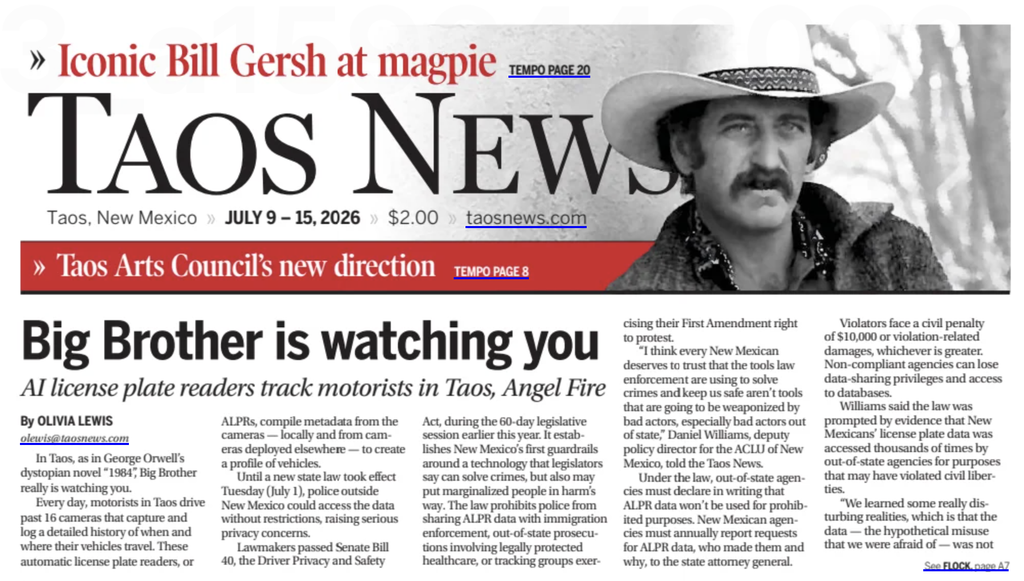
The article dug into how cameras were tracking people in Taos, Angel Fire, and Red River. It quickly ignited conversation from a broad range of community members.
That led Zach Behrens, a local community advocate, to set up an informal Deflock Taos website, email list, and start talking to people:
I myself did not wake up to Flock’s local presence until people added a handful of local cameras to the DeFlock map, which helped me see the landscape in a whole new light.
By that point, the cameras had been tracking us for nearly two years! So I started identifying even more cameras as I drove around town and began researching and talking to elected officials, before finally putting in public records requests to learn more.
Like Montoya’s petition in Albuquerque, there was an immediate response from Taos residents who shared the same concerns…
What’s been surprising to see is how powerful a little sunlight and direction has been in activating the public to apply pressure and successfully DeFlock the town. That’s owed to a blend of Taos’ strong cultural and historical roots in activism and a growing national bipartisan concern about ALPRs and other types of mass surveillance. This moment is quite astonishing to witness, and I’m glad to play a small part in it with the community.
Creating The World Our Kids Grow Up In (For Good or Bad)
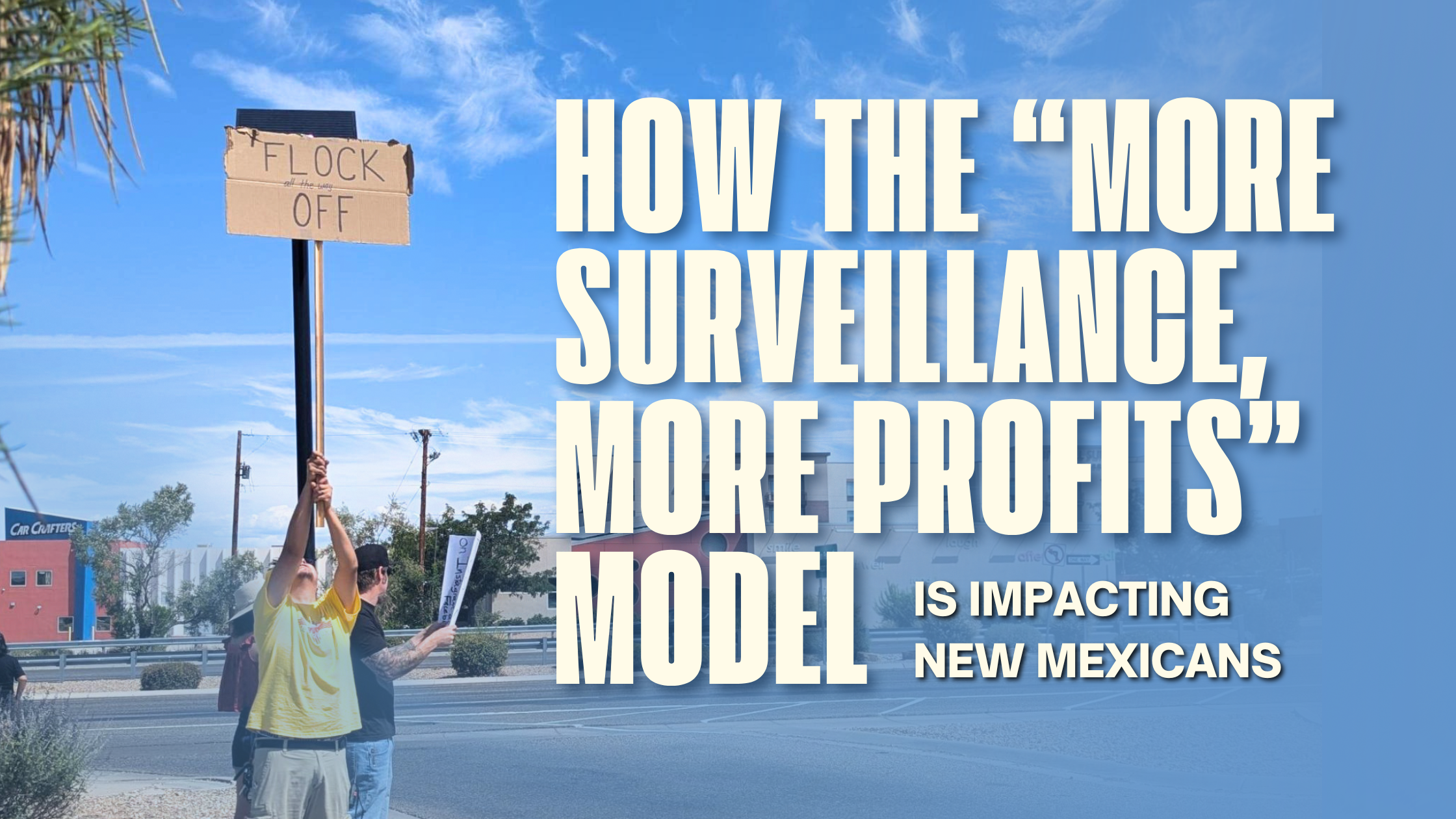
I joined Montoya and other advocates during a recent Deflock protest near the Lowes Hardware at Paseo and I-25. We talked with a dad from Rio Rancho, and when I asked him “what brought you out today” he said it was about more than what’s happening right now… it’s about the world his kids will grow up in.
I also asked both Behrens and Montoya about what they see as the bigger picture, and what public safety means to them. They pointed to the need for solutions that directly address root causes, like better mental/behavioral health access, violence prevention programs, and housing people can actually afford.
For Behrens, it was also about being efficient and responsible with funding:
$22 million was spent on the National Guard in Albuquerque and Española, two cities with plenty of cameras themselves, with no measurable impact on crime…I personally would have rather seen the $54,000 spent annually on Flock cameras over the last three years [go to] stressed housing and rental market, fixing the dilapidated park on Gusdorf Rd. with partners, or funding more homeless, mental health, and addiction services.
That aligns with the conversation I had with Montoya, who offered a closing reminder that surveillance tech is not an end by itself…
We’re all human, we’re all trying to get through this thing called life, and this type of surveillance makes that harder. I think of a quote my mom always said when I was growing up ‘don’t wait for somebody else, because you are somebody else.
This is the second in a three part series about AI powered surveillance
Part 1: How NM can set guardrails on Flock cameras and surveillance tech
Part 3: The Promise and Peril of Real Time Crime Centers (coming soon)