
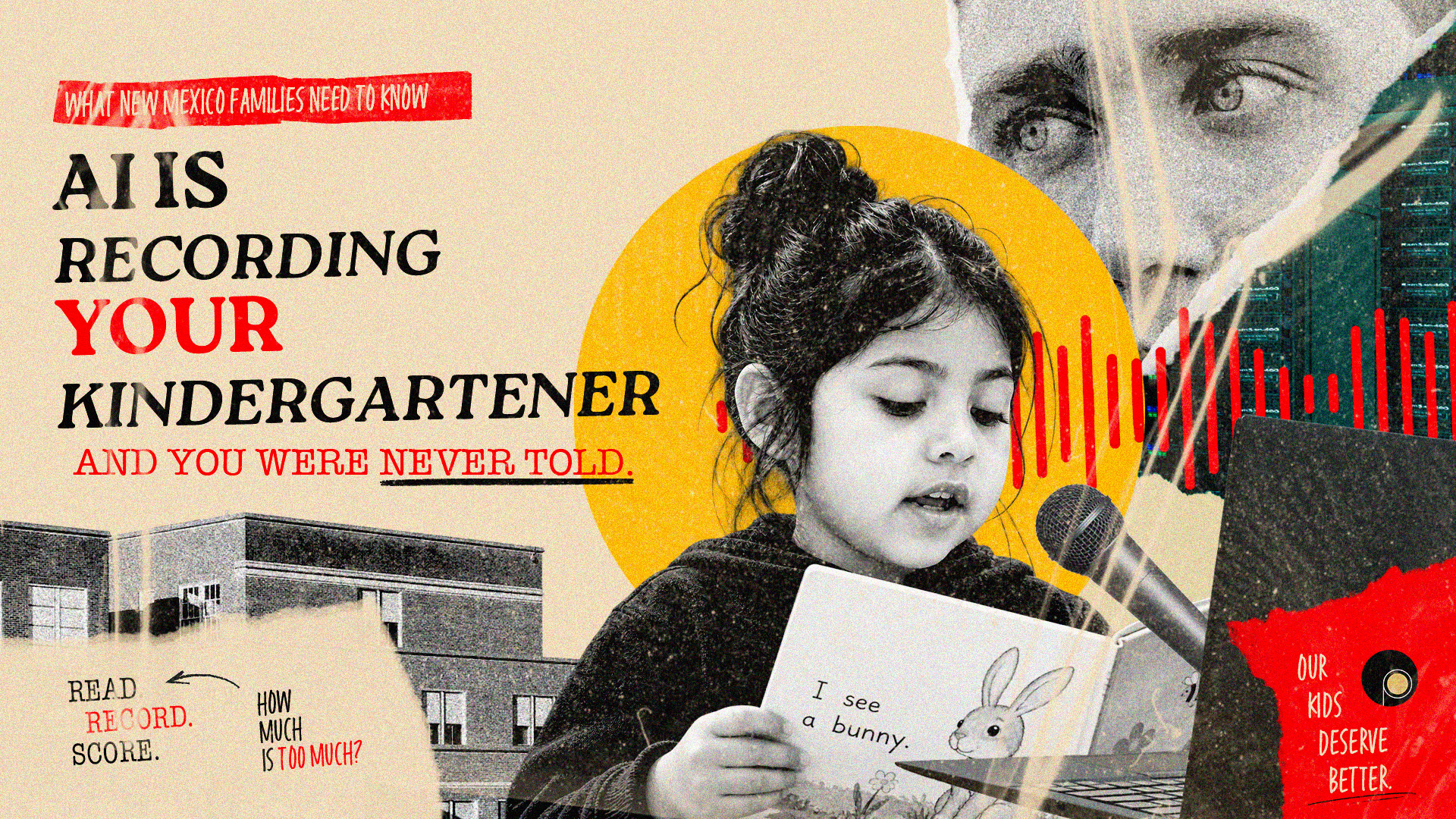

If you have a kindergartner, first-grader, or second-grader in a New Mexico public school this year, there’s a good chance your child has been reading aloud into a microphone for an AI named Amira – and you may not have been told.
Amira is a voice-based reading assessment that the New Mexico Public Education Department (PED) mandated for all K-2 students (and authorized up to grade eight) at public and charter schools beginning in the 2025-26 school year.
The program listens as children read, scores their fluency, and generates data used to measure school performance. Children flagged as “not proficient” are tested monthly, on top of the three yearly benchmarks, meaning some five-year-olds are having their voices recorded by an AI ten or more times a year.
In May, researchers at the state’s Legislative Education Study Committee confirmed what parents and teachers have been warning about for months:
- The state education department deployed Amira with no statewide student data privacy standards specific to AI
- Without going through a formal evaluation process for AI education tools
- With no meaningful transparency about where our children’s voices go or who profits from them
What’s actually happening in classrooms
Albuquerque Journal reporting from April/May documented the reality in Albuquerque Public Schools (APS) classrooms.
For example, Kindergarten teacher Celeste Hernandez, who has seven students with speech-related IEPs and eight English learners, told the Journal that Amira “is not always great at picking up the language of students, especially when they have trouble with (spoken) language.”
Special education teacher Ryan Hayes was more blunt: “If you have a kid with social communication deficits, like the type of kiddos we work with in here — with receptive, expressive and articulation delays — I feel like there should be an opt-out.” He described students groaning, crying, and struggling with increased anxiety and fear on “Amira Tuesdays” because the software couldn’t understand them.
Erik Johns, an APS teaching and learning coach, said he sees “massive fluctuations month to month” of 20 to 30 percentile points in student scores – statistically impossible. “It’s primarily because the AI is not working correctly,” he said. “I have some really, really excellent teachers here, especially in my lower grade levels, and they’re being judged on this data that’s completely inaccurate. It’s not factual, and it’s heartbreaking, because they’re working very, very hard to do the very best by our students.”
Privacy and Safety Concerns
There’s also the privacy piece the school board didn’t put in the back-to-school packet. Amira appears to have quietly updated its privacy policy in early-August after parent concerns about what was happening to their children’s voices made international news headlines.
One of the biggest changes? Going from “We also use these recordings to improve our AI models and the Amira App” to “Student voice recording and analysis are used strictly for instructional purposes and to aid the teacher.”
While the PED and Amira have both repeatedly downplayed concerns from families, all of those recordings are big business. Amira is set to make over $6M from its’ 2025-26 contracts with the state, according to the Santa Fe New Mexican. Children’s biometric data – voices – are the raw material that translate into profits.
When I exchanged emails with Ifeoma Ozoma, a local community advocate leading the Amira Opt-Out SFPS campaign, she pointed to a bigger picture: so far, the PED doesn’t seem particularly interested in putting in place comprehensive student privacy guardrails that address AI or in ensuring meaningful consent/input from families.
The state may be used to advocacy fizzling out in most circumstances, but there’s nothing more important to people than their kids, and parents are a large voting bloc who have been repeatedly disrespected by this obstinate [Public Education] Secretary and her leadership team.
AI in schools isn’t just Amira, it’s a screen-time pipeline
While Amira is the first many parents are hearing of AI in schools, it isn’t the only use of AI. APS is also piloting Google Gemini for students 13+ under the banner of “AI literacy.”
Google’s own customer story celebrates teachers cutting lesson-planning from four hours to twenty minutes. That may be true for some teachers some of the time – but the larger pattern is what parents already see at the kitchen table: more screens, more dashboards, more time spent teaching children to interact with software instead of with each other and the adults in their lives.
As local advocacy group Boost NM pointed out in a recent APS AI opt out petition, there’s a growing body of research backing what families are seeing:
- After a yearlong review, the Brookings Institution concluded that “the risks of utilizing generative AI in children’s education overshadow its benefits.”
- The National Education Policy Center has called on school leaders to pause AI adoption.
- The RAND Corporation found no measurable teaching and learning gains from AI in K-12 classrooms.
Add to that recently released OECD PISA 2025 results, which showed average reading scores falling 28 points across several dozen countries since 2015. That includes a near 25-year low for American students.
Despite tech company CEOs and investors celebrating metrics focused on “attention” and “engagement” with screens and apps, there is no substitute for qualified educators, hands on learning, and real connection.
Where families are winning
The good news is that this is not a fight families are losing. Boost NM’s petition to APS gathered nearly 800 signatures in just a few weeks. And Ozoma’s campaign has already delivered results.
Santa Fe Public Schools Superintendent Christine Griffin submitted a formal request to replace Amira with DIBELS – a teacher-administered early literacy screener developed at the University of Oregon – for kindergarten through second grade.
Shortly after, Los Alamos, Farmington, and Clayton schools joined them, and Las Cruces has also demanded that Amira delete all recordings in response to concerns raised by local families.
But Ozoma’s campaign isn’t just about one app. The bigger goal is a Student Data Privacy Framework she presented to Secretary Padilla and Superintendent Griffin – one that, in her words, would fully protect parents, guardians, and kids:
PED and districts [would need to] obtain affirmative consent from parents and guardians for the collection and use of sensitive data categories, while vendors would no longer be able to legally harvest and use student data in order to profit by improving their models and services.
What you can do right now
- Submit a written opt-out. Even if your district is moving toward DIBELS, submit a written request to your child’s principal now using the templates at AmiraOptOutSFPS.com and BoostNMSchools.org The form asks for paper or non-verbal assessment, deletion of any prior voice recordings, and written confirmation. Don’t accept a verbal “we’ll handle it.”
- Speak at your school board meeting. Public comment works. Sign up to speak in person or virtually. Bring your story. Bring a teacher. Bring a neighbor.
- Join the coalitions. Sign the petition at the Boost NM campaign page, plug into Boost New Mexico, and connect with Amira Out of SFPS if you’re in Santa Fe. These are parent-led, volunteer-run, and they are the reason any of this movement exists.
- Tell your legislator. The Legislative Education Study Committee has acknowledged the gaps. Demand a moratorium on new AI tools in schools until there are enforceable privacy safeguards and a full edtech contract audit. Look them up here: Find My Legislator.
New Mexico families show up for each other. We show up for our neighbors, our kids’ teachers, and our elders. Right now, our littlest learners need us to show up for them – at the school board, in the legislature, and in our own kitchens, where a single written opt-out can keep a five-year-old’s voice out of a corporate training dataset.
As Boost NM reminded us all, a child’s voice is not a product. Our kids are not users. And the answer to a generation-wide reading crisis will never be found in a venture-backed app – it will be found in the people we choose to put in front of our children.